
LED face masks have gone from clinical curiosity to bathroom mainstay in under a decade. Open any "best LED mask" list and you'll see the same handful of names — Omnilux, CurrentBody, Dr. Dennis Gross, and a growing field of newer brands like Beautimate. Prices range from $199 to $470, marketing claims overlap, and most "best of" lists are paid affiliate placements.
This guide isn't a "best of" list. It's an educational breakdown of the specifications that actually affect results — sourced directly from each brand's published product page — so you can decide for yourself what matters for your skin.

How LED light therapy actually works
LED (light-emitting diode) therapy uses specific wavelengths of visible and near-infrared light to interact with skin cells at different depths. Three wavelength ranges dominate the at-home category:
- Red light (around 630–660 nm) is absorbed by mitochondria in skin cells. The most-cited clinical use is supporting collagen and elastin production for fine lines and skin firmness.
- Blue light (around 415–460 nm) targets Cutibacterium acnes, the bacterium associated with inflammatory acne. The largest randomized controlled trial of red+blue light combined therapy for mild-to-moderate acne reported a 76% improvement in inflammatory lesions over 12 weeks (Papageorgiou et al., BJD 2000).
- Near-infrared (around 830–880 nm) penetrates deeper than red light, reaching the dermis where fibroblast cells produce collagen and elastin. A 2024 systematic review summarized current evidence for red and near-infrared LED in dermatology (Duke 2024 review).
Wavelengths outside these ranges (amber, deep red at 660 nm, deep near-infrared at 1072 nm) have smaller but growing bodies of evidence, often for inflammation and deeper tissue effects.

The five masks compared
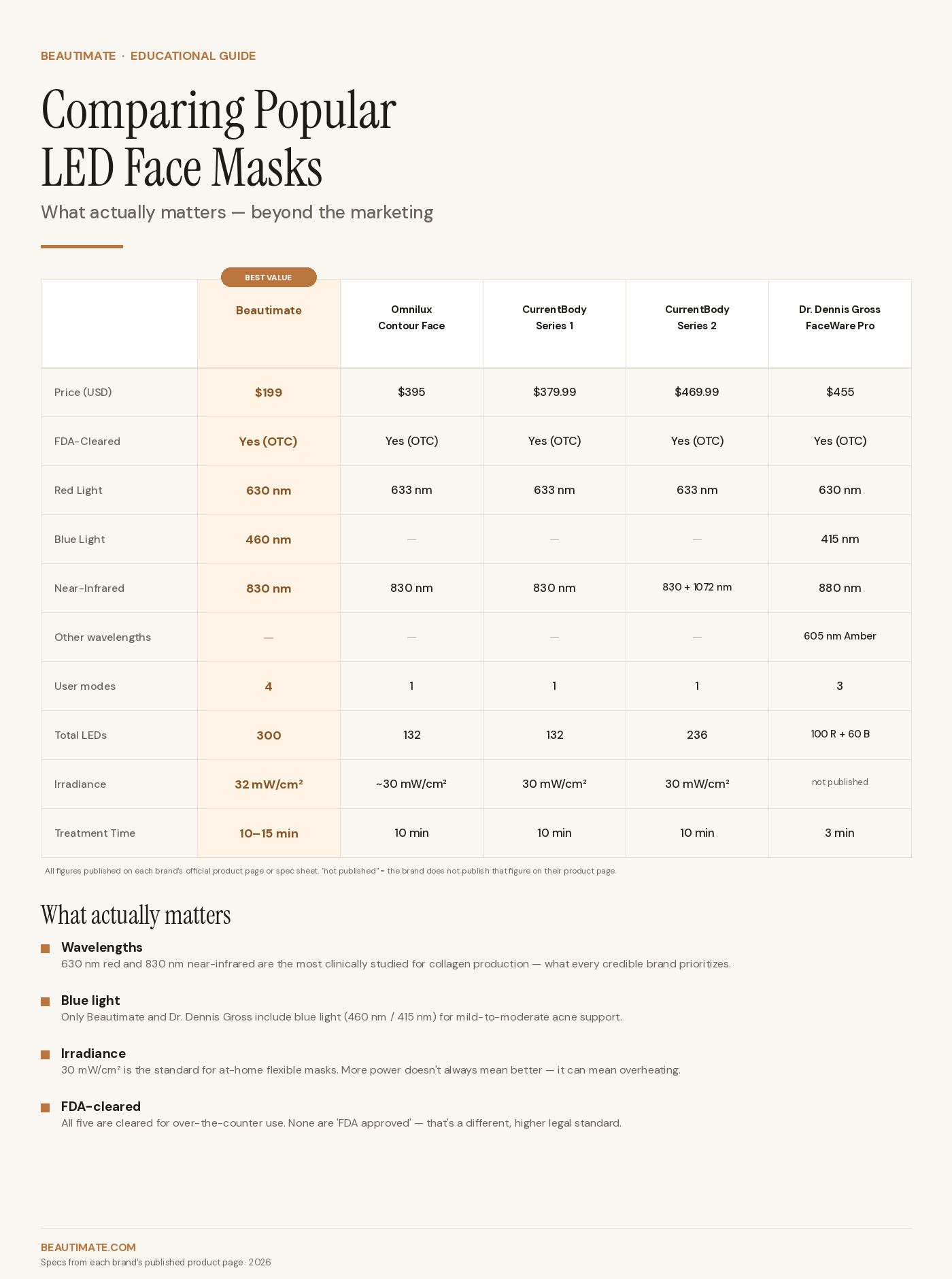
| Beautimate | Omnilux Contour Face |
CurrentBody Series 1 |
CurrentBody Series 2 |
Dr. Dennis Gross FaceWare Pro |
|
|---|---|---|---|---|---|
| Price (USD) | $199 | $395 | $379.99 | $469.99 | $455 |
| Red light | 630 nm | 633 nm | 633 nm | 633 nm | 630 nm |
| Blue light | 460 nm | — | — | — | 415 nm |
| Near-infrared | 830 nm | 830 nm | 830 nm | 830 + 1072 nm | 880 nm |
| Other wavelengths | — | — | — | — | 605 nm Amber |
| User-selectable modes | 4 (Red / Blue / NIR / Mix) | 1 (combined) | 1 (combined) | 1 (combined) | 3 (Red / Blue / Red+Blue) |
| LEDs | 300 | 132 | 132 (66 R + 66 NIR) | 236 | 100 red + 60 blue |
| Irradiance | 32 mW/cm² | ~30 mW/cm² | 30 mW/cm² | 30 mW/cm² | Not published on product page |
| Treatment time | 10–15 min | 10 min | 10 min | 10 min | 3 min |
| FDA-cleared | Yes (OTC) | Yes (OTC) | Yes (OTC) | Yes (OTC) | Yes (OTC) |
All figures are sourced directly from each brand's official product page or published spec sheet. "Not published on product page" means that figure is not listed on the manufacturer's product page at time of writing.
Source verification
- Beautimate LED Light Therapy Mask — specifications published on product page
- Omnilux Contour Face — wavelengths and LED count from product page; irradiance from Omnilux Help Center
- CurrentBody Skin LED Light Therapy Face Mask — both Series 1 and Series 2
- Dr. Dennis Gross FaceWare Pro product page — wavelengths from the published comparison table; LED count from product page text; irradiance is not published on the product page
What "FDA-cleared" actually means
Every LED mask in this guide is marketed as "FDA-cleared." This is true — but the phrase is widely misunderstood, and consumers deserve to know what it covers and what it doesn't.
Three FDA pathways, not two
Most people only hear about FDA-approved and FDA-cleared. There's actually a third pathway that applies to several newer LED therapy claims:
- FDA-approved is reserved for high-risk Class III devices, where the manufacturer must prove safety and efficacy through clinical trials before going to market. No consumer LED face mask is FDA-approved.
- FDA-cleared (510(k)) means the manufacturer demonstrated their device is "substantially equivalent" to a similar device already legally on the market. It does not require its own clinical trials. It is a much lower regulatory bar (CITI Program explainer).
- FDA De Novo grant is used when a device is novel — there's no existing predicate to compare to. The manufacturer must establish safety, effectiveness, and special controls (often including clinical data). After grant, the device becomes a predicate that future 510(k) submissions can cite. The first FDA-authorized 1072 nm LED device (the ViruLite Cold Sore Machine, DEN090012) used this pathway in 2012 because no predicate existed at the time.
Any brand using the word "approved" in marketing — for any LED mask — is technically incorrect.
Clearance is wavelength- and use-specific
A 510(k) clearance covers specific wavelengths and a specific intended use — usually "wrinkle reduction" (product code OHS) or "treatment of inflammatory acne" (product code OLP). When a brand markets a device, it's worth checking that the wavelengths and indications in their FDA filing match what's in their marketing.
How to verify any LED mask's FDA status yourself
- Go to the FDA 510(k) Premarket Notification Database (or the De Novo database for novel devices).
- Search by applicant (brand or manufacturer name) or K-number if the brand publishes it.
- Open the result and look at the "Indications for Use" statement and the "Device Description." This tells you exactly what the FDA reviewed — wavelengths, LED count, intended use.
- Compare the FDA record against the brand's marketing. If the marketed wavelengths, LED counts, or claims significantly exceed what's documented, that's worth knowing before you buy.
A transparent brand should be able to provide its K-number on request — the number itself is public.
How to think about each spec
Wavelength: the most important variable
The strongest clinical evidence is for 630–660 nm red light (collagen, fine lines) and 415 nm blue light (acne bacteria). The strongest near-infrared evidence is for 830 nm (deeper collagen stimulation) — this is the wavelength used in most clinical studies and the most common in FDA-cleared masks.
A note on blue light: the foundational acne studies used 415 nm, but the clinically studied blue range extends to roughly 460 nm. The Beautimate mask sits at 460 nm — within that range and toward the gentler, slightly deeper-penetrating end of the blue band.
Other wavelengths (605 nm amber, 1072 nm deep near-infrared, 880 nm near-infrared) have smaller bodies of evidence. They may add benefits, but they don't replace the foundational red+NIR (or red+blue+NIR) combination that's been studied for decades.
Irradiance: 30 mW/cm² is the standard
Irradiance (often labeled "power density") measures how much light energy hits each square centimeter of skin. The dermatology research consensus for skin rejuvenation suggests 30–60 mW/cm² at the skin surface for flexible at-home masks. Too low (under 20 mW/cm²) and the dose is insufficient. Too high and you risk overheating or skin irritation.
The three flexible silicone masks in this comparison that publish irradiance — Beautimate (32 mW/cm²), Omnilux (~30 mW/cm²), and CurrentBody (30 mW/cm²) — all land at the 30–32 mW/cm² mark. If a brand doesn't publish irradiance on its product page, you can request it from customer service before buying.
LED count: helpful, but not magic
More LEDs distributed across the face mean more even coverage and fewer "cold spots." But beyond a certain density, additional LEDs don't multiply results — they just spread the same total energy over more emitters. 300 LEDs at 32 mW/cm² is not 3× more effective than 100 LEDs at 32 mW/cm² — the per-skin-area dose is what matters.
Treatment time: a function of irradiance
A short, high-intensity session can deliver a similar total dose (in J/cm²) to a longer, lower-intensity session. The right number depends on the device. Always follow the manufacturer's recommended protocol — masks are designed for specific exposure durations based on their measured output.
Session frequency and consistency
Consistency matters more than any individual specification. The clinical studies that produced visible results all used the device 3–5 times per week for 8–12 weeks minimum. A more powerful mask used twice a month will not outperform a moderate mask used four times a week.
Marketing myths to watch for

"Doctor-developed" / "Dermatologist-formulated"
A brand can use this language whether or not the underlying device design follows clinical evidence. Look at the wavelength specs, not the founder's photo.
"Medical-grade LEDs"
There is no FDA or industry standard for "medical-grade." It's a marketing term, not a regulatory one. The meaningful question: what is the device's irradiance and wavelength precision?
"Highest LED count on the market"
LED count alone doesn't predict results. A 500-LED mask at 15 mW/cm² is less effective than a 200-LED mask at 30 mW/cm².
"More wavelengths = better"
Stacking extra wavelengths (amber, deep red, multiple NIR) may add marginal benefits, but red + NIR remain the foundation of every credible LED therapy study. Devices that lead with "5 wavelengths" or "7 wavelengths" often deliver smaller doses of each one.
"Best LED mask 2026" lists
Most of these are paid affiliate placements. Check the disclosure at the bottom of any review site. A useful list will publish specifications, not just brand opinions.
So which mask should you choose?
Different needs lead to different answers. Here's an honest map:
You only want anti-aging and don't have acne concerns
Omnilux Contour Face ($395) and CurrentBody Series 1 ($379.99) both use the well-established 633 nm + 830 nm combination. CurrentBody Series 2 ($469.99) adds a third wavelength — 1072 nm deep near-infrared — for an additional premium.
You want anti-aging and acne support, plus full mode control, without paying $400+
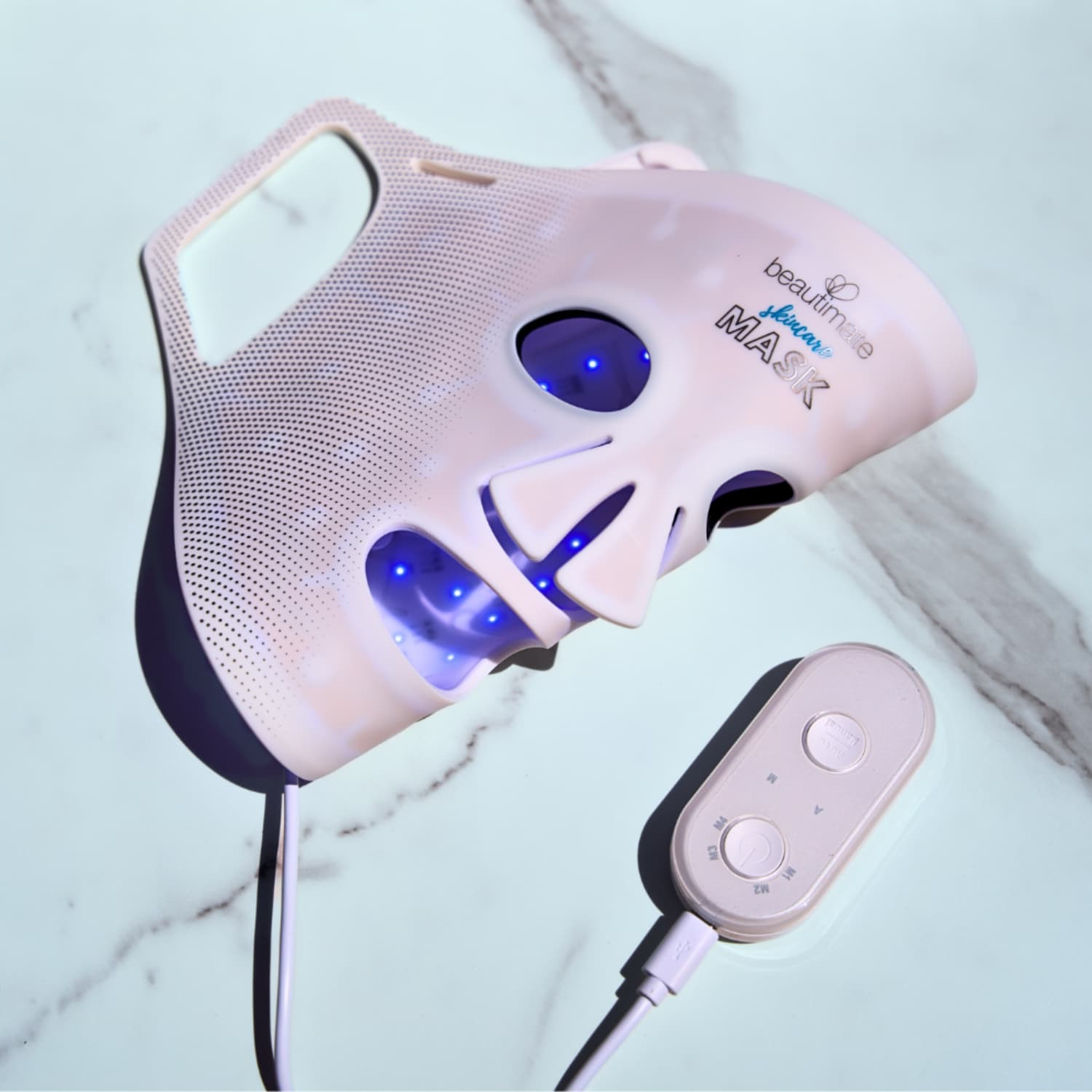
The Beautimate LED Light Therapy Mask delivers the three clinically-validated wavelengths most people actually need — 630 nm red, 460 nm blue, and 830 nm near-infrared — at $199. Four user-selectable modes (Red / Blue / NIR / Mix) let you target a specific concern instead of one fixed combined dose.
You want the shortest possible sessions
Dr. Dennis Gross FaceWare Pro at 3 minutes per session is the fastest in this comparison. The rigid mask design and short session is its primary differentiator.
Your priority is wavelength precision and per-device testing
CurrentBody Series 2 publishes its Veritace® per-device wavelength precision testing — currently one of the most rigorous quality-assurance disclosures in the at-home category.
FAQ
Are LED face masks safe for everyone?
Most healthy adults tolerate LED therapy well. People who are pregnant, taking photosensitizing medications (some antibiotics, isotretinoin, certain antidepressants), or who have a history of light-induced skin conditions should consult a dermatologist first. Always use the included eye protection.
How long until I see results?
Clinical studies report visible improvements at 4–6 weeks for acne and 8–12 weeks for fine lines, with consistent 3–5×/week use. Day-to-day changes are subtle; many people take a starting photo and compare at week 4 and week 12.
Can I use it every day?
Most manufacturers recommend 3–5 times per week. Daily use is usually safe but offers no documented added benefit over the recommended frequency.
Is 1072 nm light a laser?
No. Whether light is a laser or an LED depends on how it's produced — lasers emit coherent, focused beams; LEDs emit diffuse, scattered light across many emitters. Both can use the same wavelengths. Consumer LED masks at 1072 nm use LEDs at low irradiance (~30 mW/cm²), not focused laser beams. Class II OTC clearance covers them just like 633 nm or 830 nm LED devices.
Does insurance cover LED masks?
These are over-the-counter consumer devices, so they aren't covered by health insurance. Many qualify for HSA/FSA reimbursement — check with your account administrator.
What about LED mask side effects?
Mild, temporary skin warming and redness during or shortly after treatment is normal. Persistent redness, irritation, or new pigmentation changes warrant stopping use and consulting a dermatologist.
Are FDA-cleared LED masks proven to work?
"FDA-cleared" via the 510(k) pathway means the device is substantially equivalent to a predicate device — it does not require a clinical trial demonstrating efficacy for that specific device. Clinical evidence varies by wavelength and by individual product. The strongest evidence base is for red light (630–660 nm) combined with near-infrared (830 nm) for skin rejuvenation, and for blue light (415 nm) plus red light for inflammatory acne.
The bottom line
LED therapy works best when you match the device to your actual goals — and when you use it consistently. The wavelengths and irradiance that show up in clinical studies are remarkably similar across price points. The biggest gap between a $199 mask and a $470 mask is usually marketing positioning, build quality, and one or two specialty wavelengths — not the foundational red + near-infrared treatment that's been studied for decades.
When you're comparing options, the four things that actually predict outcomes:
- Wavelengths in the clinically-validated range (630 nm red, 830 nm NIR, 415–460 nm blue if you have acne concerns)
- Irradiance in the 30–60 mW/cm² range at skin contact
- Coverage across your full face
- Your own consistency — used 3–5 times per week for at least 8 weeks
Everything else is secondary.
Sources
- Beautimate LED Light Therapy Mask product page
- Omnilux Contour Face product page and Omnilux Help Center
- CurrentBody Skin LED Light Therapy Face Mask — Series 1 and Series 2 product pages
- Dr. Dennis Gross DRx SpectraLite FaceWare Pro product page
- Papageorgiou et al. 2000 — Phototherapy with blue (415 nm) and red (660 nm) light in the treatment of acne vulgaris (BJD)
- Duke 2024 systematic review on red LED in dermatology
- CITI Program — FDA Clearance vs. Approval
- FDA 510(k) Premarket Notification Database
- FDA De Novo Classification Database
- FDA De Novo DEN090012 — ViruLite Cold Sore Machine (first 1072 nm LED authorization)